

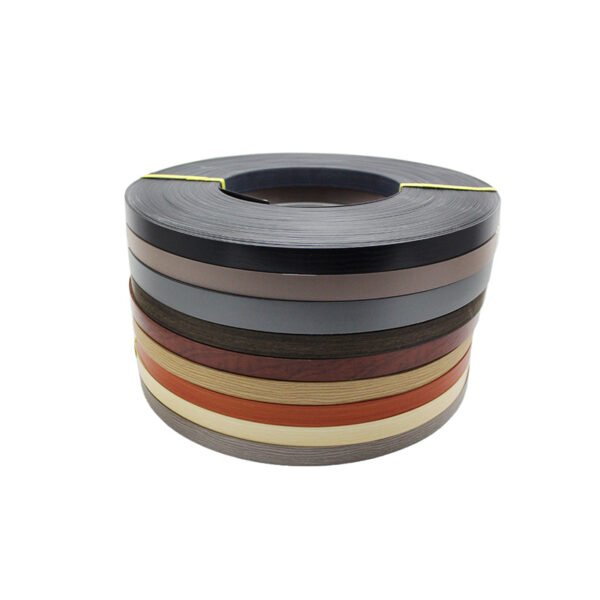
ABS Edge Banding — The Premium Choice When Melamine Just Isn’t Enough
What Makes ABS Edge Banding Different
ABS stands for Acrylonitrile Butadiene Styrene — same family of plastic as Lego bricks and automotive interior trim. That should tell you something about its properties: impact resistance, dimensional stability, and a clean surface that holds color extremely well.
Compared to PVC, ABS has three things going for it that matter in furniture:
- No chlorine content — which is why European buyers, especially in Germany and Scandinavia, push for it. PVC releases chlorine compounds when burned or processed, and that’s increasingly a regulatory issue under EU sustainability directives.
- Better impact resistance — ABS holds up to knocks and bumps that would dent or crack PVC, especially at lower temperatures.
- Cleaner thermal processing — when you run it through a laser edge bander, you get a near-invisible glue line that PVC just can’t match consistently.
It costs more than PVC. Usually 20–35% more. The buyers who choose it are the ones who’ve calculated that the warranty savings, the regulatory clearance, or the premium positioning justifies the cost.
Our ABS Edge Banding Specifications
We keep the product range focused on what serious B2B buyers actually order:
Thickness: 0.4mm, 0.8mm, 1mm, 2mm, and 3mm. The 1–3mm thick ABS edge banding is the most common ask — it’s where ABS earns its keep on impact-prone surfaces like kitchen counters and commercial furniture edges.
Width: 15mm to 55mm standard, custom widths to 100mm available.
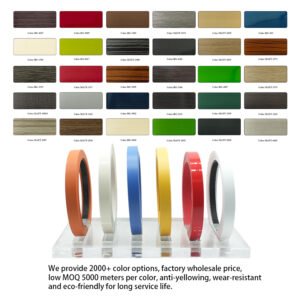
Colors and finishes: Solid colors, high-gloss, super matte, woodgrain, metallic, and 3D embossed textures. We hold over 600 colors in regular production and can custom-match to most major panel brands — Egger, Kronospan, Arpa, Formica. Send a sample, we’ll match it.
Roll length: 100m and 150m standard. Custom lengths for distributors.
Back coating options:
- Standard primer for EVA hot-melt glue
- PUR-ready primer for polyurethane adhesive
- AirTec/laser-compatible for invisible glue line applications
The Performance Specs That Actually Matter
I’ll skip the marketing language and tell you what we test and what the numbers mean.
Impact Resistance — Where ABS Earns Its Price
We run Izod impact tests on every production batch. Our standard ABS banding hits 18–22 kJ/m² at room temperature, and — here’s the part that matters for cold-climate buyers — it holds above 12 kJ/m² at -20°C. PVC drops to brittle territory at those temperatures. ABS doesn’t.
What this means in practice: if you’re shipping kitchen cabinets to Canada, Northern Europe, or Russia, ABS won’t crack during winter delivery or installation. We’ve had buyers in Finland specifically switch from PVC after their installers kept finding hairline cracks on door edges in January.
Color Stability Under UV
Light colors and whites are the test case. Our ABS uses UV-stabilized pigments and runs Delta-E under 1.2 after 500 hours of QUV accelerated weathering. That’s better than our melamine line, and significantly better than budget ABS from less rigorous factories.
For high-end residential furniture exposed to natural daylight, this is the spec that prevents your white kitchen cabinets from looking yellow after three years.
Chemical Resistance
ABS handles common kitchen chemicals well — citric acid, detergents, alcohol-based cleaners, cooking oils. It doesn’t handle acetone or strong solvents, so don’t tell your end users they can clean it with nail polish remover. We provide a full chemical resistance datasheet with every shipment.
ABS edge banding Compatibility
This is the application where ABS really separates itself. When you run ABS through a laser or hot-air edge bander (Homag laserTec, airTec, IMA Bima, SCM Stefani with laser unit), the back functional layer melts and bonds directly to the panel — no visible glue line at all. It looks like the edge is part of the panel.
For premium furniture brands, this is non-negotiable. We supply laser-compatible ABS to several European furniture manufacturers running 24/7 production on Homag lines, and the spec consistency has to be tight or the bond fails. We hold ±0.03mm thickness tolerance on laser-grade product, which is tighter than industry standard.
Who Should Actually Buy ABS Edge Banding
Let me be direct about the customer profile, because ABS isn’t the right answer for every furniture project.
Buy ABS if you’re making:
- Premium kitchen cabinets, especially for European or North American markets
- Contract furniture for hotels, offices, healthcare — anywhere durability and certifications matter
Children’s furniture or daycare furniture where impact safety and chemical compliance matter
- Furniture shipping into cold-climate markets where PVC gets brittle
- Anything spec’d for ABS edge banding — invisible glue line is an ABS thing
- Products targeting EU markets where buyers prefer chlorine-free materials
Skip ABS and use PVC or melamine if:
- You’re price-sensitive on a residential mid-market product
- Your client hasn’t specifically asked for ABS
- The application doesn’t see impact stress or thermal extremes
- You’re matching an existing melamine panel finish — melamine banding will match more naturally
Honest advice: half the buyers who ask us about ABS actually need our PVC line. We tell them. Saves everyone time.
What Working With Us Looks Like — Two Real Cases
Contract furniture maker in the Netherlands, supplying hotel chains across Europe. They came to us in 2022 specifically because their previous Italian supplier had an 8-week lead time they couldn’t work with. We held inventory on their six core colors, shipped on call, and color-matched a custom walnut woodgrain to their interior designer’s spec. They’re now consuming around 80,000m a month of ABS, all laser-grade.
Kitchen cabinet manufacturer in Toronto — switched from PVC after warranty claims spiked during the 2023 winter. Cold-weather brittleness was the diagnosis. We supplied test samples in their three most-used colors, their QC team ran impact tests at -25°C, and ABS held where PVC failed. They’ve been running our ABS for two years, zero cold-crack complaints since.
Not every project ends in a sale. We’ve had inquiries where the buyer’s machine couldn’t handle ABS (some older Chinese-made edge banders don’t have the temperature control for clean ABS bonding) and we told them upfront — don’t buy from us, your machine will give you bad results. That’s the kind of supplier we want to be.
Certifications and Compliance
This matters more for ABS than for other edge banding categories, because the buyers asking for ABS usually need the paperwork.
- REACH compliant — full SVHC documentation for EU customs
- CARB Phase 2 documentation for North American buyers
- ISO 9001 certified production
We can supply documentation packages for customs clearance in regulated markets. Tell us the destination and we’ll prepare the right paperwork.
Logistics, Pricing, MOQ
MOQ: 10000m per color for custom-matched colors. Mix freely within a 20ft container.
Lead time: Stock colors ship in 7–12 days. Custom-matched ABS runs 25–30 days from formula confirmation.
Pricing: Direct factory, no trader margin. We won’t be the cheapest ABS quote you receive — there are factories cutting corners on resin grade and UV stabilizer that we won’t match. We’ll be competitive against any supplier shipping the same actual quality.
Shipping: FOB Qingdao standard. CIF, DDP, and door-to-door available. Established forwarder relationships for Europe, North America, Australia, and the Middle East.
Payment: 30% deposit, 70% against B/L copy for first orders. Net 30 for established repeat clients.
Samples: Free swatch samples for qualified B2B buyers. We pay for the abs edge banding samples, you handle the courier — or we deduct shipping from your first order.
FAQ
Q: ABS vs PVC — which one should I order?
If your end market is EU, if you’re shipping to cold climates, if you’re running laser edge banding, or if your client specified ABS — go ABS. If you’re price-sensitive and the application is interior residential furniture in a temperate climate, PVC is honestly fine. We sell both. We’re not going to upsell you.
Q: Can I run ABS on my existing edge banding machine?
Most modern hot-melt machines handle ABS without modification — Homag, Brandt, SCM, Biesse, IMA, plus higher-end Chinese brands like Nanxing and KDT. Older machines without precise temperature control sometimes struggle. Tell us your machine model and we’ll confirm.
Q: Does ABS edge banding work with PUR adhesive?
Yes, and PUR with ABS gives you the strongest possible bond — basically permanent. We supply PUR-ready back coating on request.
Q: Can you color-match to my panel supplier?
Yes. Send a physical panel sample (not a photo). Our lab matches to Delta-E under 1.0. We’ve matched to all major European and North American panel brands.
Q: What’s the difference between standard ABS and laser-grade ABS?
Laser-grade has a specially engineered functional back layer that melts and bonds when activated by laser or hot air. It also holds tighter dimensional tolerance (±0.03mm vs ±0.05mm). Costs about 15% more than standard ABS but delivers the invisible glue line finish.
Q: How long does ABS edge banding last?
In typical indoor furniture applications, 10–15 years before any visible degradation. The first failure mode is usually surface micro-scratching from accumulated use. Color stays stable, bonding stays intact.
Q: Do you do private label?
Yes. Custom labels, custom roll lengths, branded packaging. MOQ is one 20ft container with mixable colors.
Q: What if the batch I receive doesn’t match the approved sample?
Tell us with photos and batch numbers immediately. We retain samples from every production run for 12 months. Legitimate quality issues get replacement or credit, no argument.