

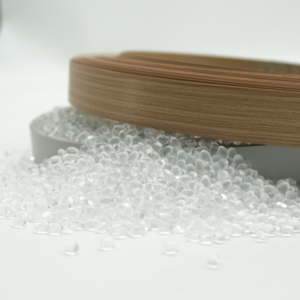
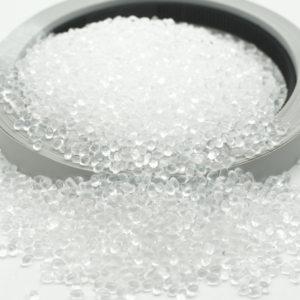
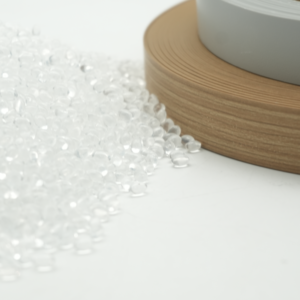
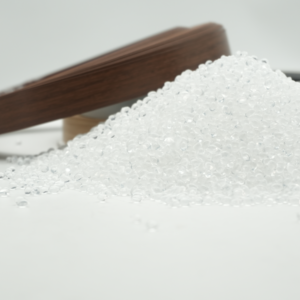
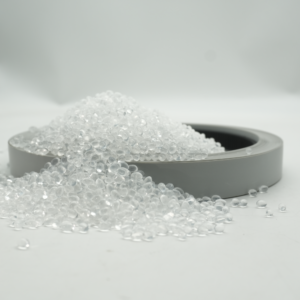
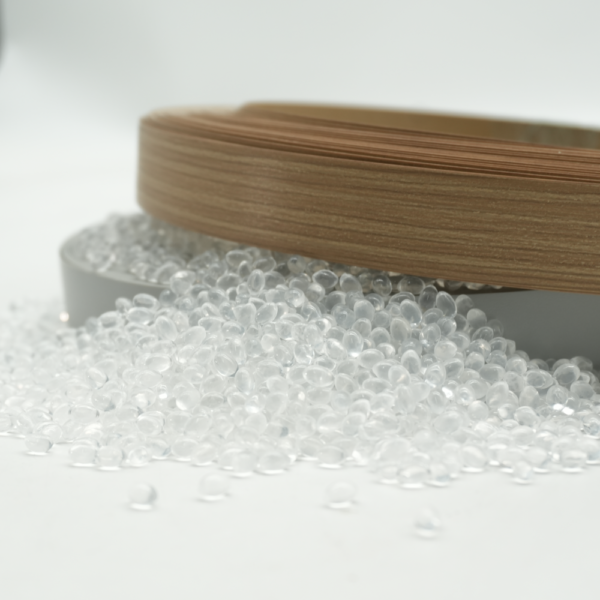
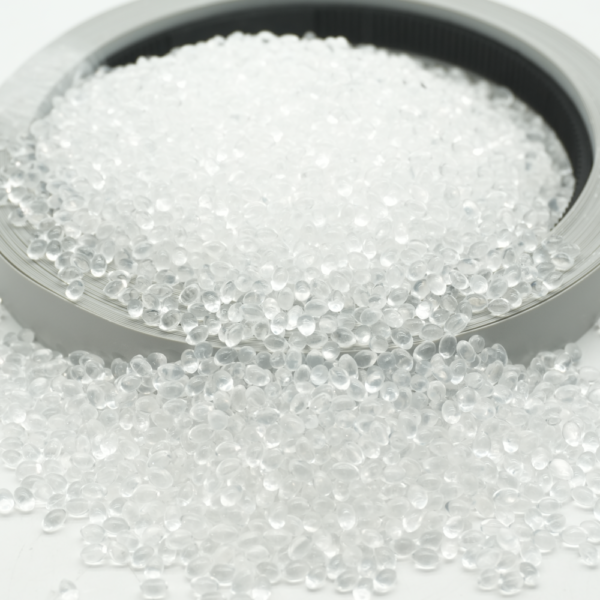
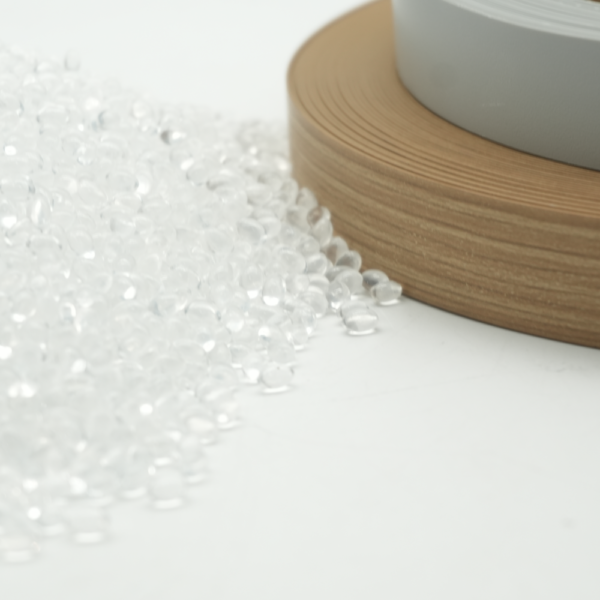
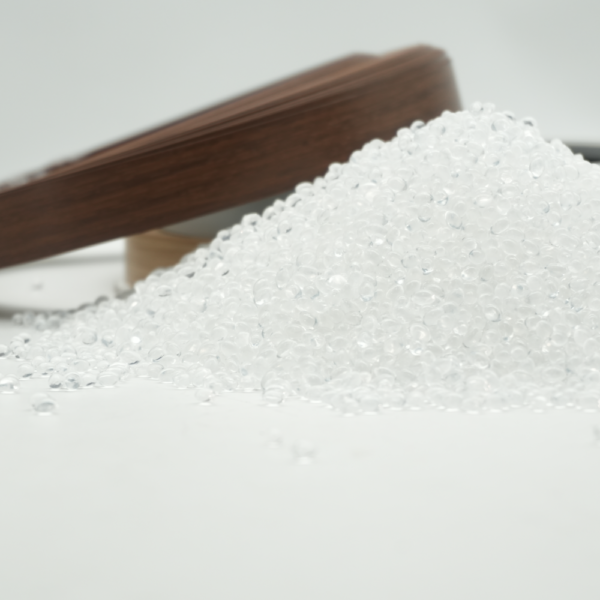
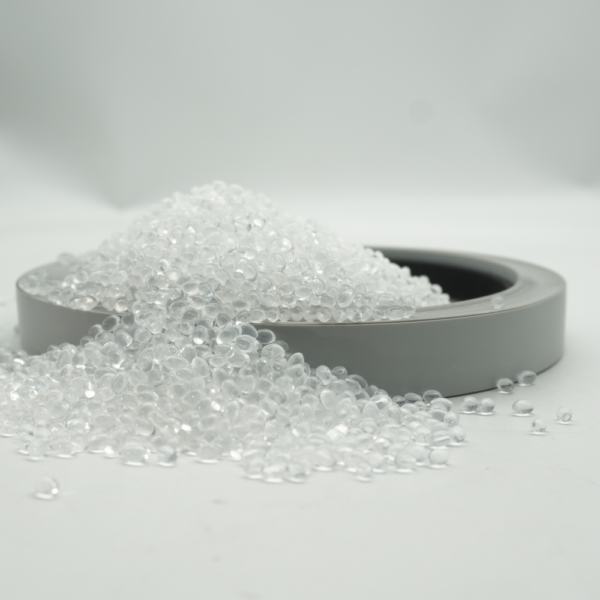
Edge Banding Hot Melt Glue — EVA Adhesive Manufacturer with Imported Raw Materials
Why Furniture Manufacturers Choose Luyao Edge banding hot melt glue
1. 100% Imported EVA Raw Materials — Batch-to-Batch Consistency
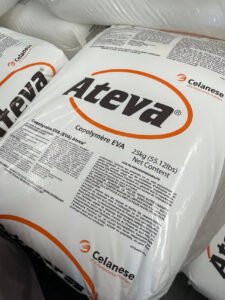
We don’t compromise on the base resin. All EVA used in our Edge banding hot melt glue is imported “Ateva”,ensuring that every batch you receive has the same melting point, same viscosity, same open time as the last one.
What this means on your production floor: once your operator dials in the temperature setting on your edge bander, they won’t need to re-adjust it batch after batch. No surprises, no rejected panels, no wasted production time.
2. High Bond Strength, Low Consumption
Our hot melt glue is engineered for strong initial tack and lower glue consumption per meter of panel edge. In side-by-side testing with “Henkel”, our customers report:
- Glue usage reduced by 30%–35%
- Bond line thickness consistently at 0.1–0.2 mm
- No visible glue line on light-colored edge bands
Less glue, stronger bond, lower cost per panel — that’s how we help OEM furniture factories protect margin.
3. Formaldehyde-Free, REACH & RoHS Compliant
For exports into Europe, the Middle East, and South America, compliance is non-negotiable. Our hot melt glue is:
- Formaldehyde-free — safe for indoor furniture, children’s furniture, and kitchen cabinets
- REACH compliant (EU regulation)
- RoHS compliant
- Full SDS / MSDS available on request in Russian, Spanish, French, German, English
4. Custom OEM Packaging
We’ve been supplying private-label Edge banding hot melt glue to distributors in Saudi Arabia, the United Arab Emirates, India, Uzbekistan, Chile, Peru, Mexico, etc. for 12 years. Standard OEM options:
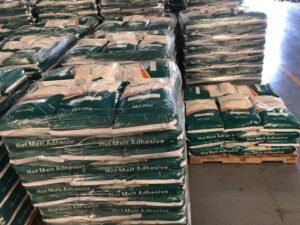
- Custom logo printing on 25kg bags
- Custom brand name on the product
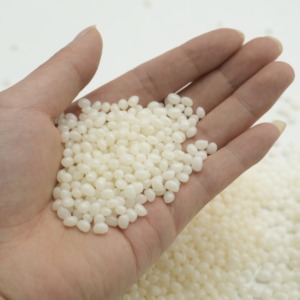
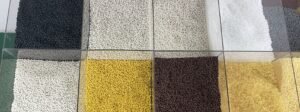
- Custom color of granules ( white / black / brown / yellow / Transparent, mixed etc)
- Bag designs in your local language
EVA Hot Melt Glue Specifications
We produce two temperature grades to fit every edge banding machine on the market:
| Specification | Low-Temp | Standard |
| Application Temperature | 150–180°C | 180–210°C |
| Softening Point | 80–95°C | 95–110°C |
| Color | white / black / brown / yellow / Transparent, mixed | Same |
| Form | Granule | Granule |
| Best For | Modern edge banders, fast feed speed, energy saving | Older machines, thick edge bands, low-density particleboard |
| Compatible Machines | Homag, Biesse, SCM, IMA (modern models) | All edge banders incl. older Nanxing, Jidong |
How to Choose the Right Hot Melt Glue — A Technical Guide
Choosing the right hot melt glue isn’t about picking the “best” one — it’s about matching the glue to your machine, your panel material, and your production speed. Here’s what 15+ years of supplying edge banding factories has taught us:
Viscosity — Higher Isn’t Always Better
Viscosity describes how thick or thin the molten glue is at application temperature. A common misconception is that “higher viscosity = better glue.” That’s not true.
- High-viscosity hot melt → stronger initial tack,
- High-viscosity hot melt → stronger initial tack, but poorer spreading on the edge band. Best for low-quality particleboard with uneven surfaces — the thicker glue fills the gaps.
- Low-viscosity hot melt → uses less glue per meter, better wetting on the substrate, cleaner glue line. Best for high-quality MDF and dense particleboard with smooth surfaces.
Our recommendation: if you’re producing standard cabinet and wardrobe panels with quality MDF, go with our lower-viscosity grade for cost savings. If you’re working with budget particleboard or have inconsistent panel quality, choose the higher-viscosity grade for reliable bonding.
Softening Point vs. Application Temperature — Don’t Confuse the Two
These are two different specs that customers often mix up:
- Softening Point (80–120°C) = the temperature at which the glue starts to soften. This indicates the heat resistance of the finished bond. A higher softening point means the finished furniture can withstand higher ambient temperatures without the edge band peeling off — critical for furniture shipped to Middle East markets where summer storage temperatures can exceed 50°C.
- Application Temperature (150–210°C) = the temperature of the glue roller on your edge banding machine. The glue only reaches optimum bond strength when the roller temperature is in the correct range. Too cold = weak bond. Too hot = glue degradation and carbonization in the glue pot.
- Rule of thumb: choose softening point based on your end market climate. Choose application temperature based on your edge banding machine.
Open Time Must Match Your Feed Speed
Open time is the window between when the glue is applied to the edge band and when the band is pressed onto the panel. This must match your edge banding machine’s feed speed:
| Feed Speed | Open Time Required | Recommended Grade |
|---|---|---|
| 15–20 m/min (standard) | 6–10 seconds | AEB-E200 standard |
| 20–30 m/min (high-speed) | 3–6 seconds | AEB-E170 low-temp / fast |
| Above 30 m/min (industrial) | 2–4 seconds | Custom formulation — contact us |
If your open time is too long for your feed speed, the glue starts cooling before pressing — resulting in weak bonds and visible glue lines. If it’s too short, the glue sets before the band is properly positioned.
Not sure which grade fits your machine? Send us your edge bander model and panel material — we’ll recommend the right formulation. Free samples available.
Compatible Edge Banding Machines
Our hot melt glue is field-tested on:
- European brands: Homag, Biesse, SCM, IMA, Felder, Holzher
- Both automatic and semi-automatic edge banders
- Both straight-line and contour edge banding
Trusted by Furniture Manufacturers Across [X] Countries
Asia Edge Banding supplies Edge banding hot melt glue and matching PVC / ABS / melamine edge bands to OEM furniture factories and panel distributors in over [X] countries, including:
- 🌍 Europe: United Kingdom, Poland, Ukraine
- 🌍 Middle East: Saudi Arabia, the UAE, Egypt, etc.
- 🌎 South America: Peru, Mexico, Chile, Ecuador, Argentina, Panama ,etc.
Frequently Asked Questions
Can your Edge banding hot melt glue work with my [Homag / Biesse / Nanxing] edge bander?
Yes. We supply EVA hot melt granules compatible with all major edge banding machine brands. Send us your machine model and we’ll recommend the right temperature grade (150–180°C or 180–210°C).
What’s the shelf life of Edge banding hot melt glue?
12 months from production date, when stored in a dry environment below 30°C in sealed bags. We recommend using older stock first (FIFO).
Do you provide samples?
Yes. We offer free 1–2 kg samples for qualified furniture manufacturers and distributors. You only cover the shipping cost. Contact us with your company details and machine model.
What’s the minimum order quantity (MOQ)?
- Standard packaging (25kg bags): 500 kg minimum
- OEM custom packaging: 1,000 kg minimum per design
- Mixed container with edge banding strips: no minimum for the glue portion
How long is the production lead time?
- Stock items: 3–5 days
- Custom color or OEM packaging: 15–20 days
- Full 20ft container of mixed edge banding products: 20–25 days
Is your Edge banding hot melt glue safe for children’s furniture?
Yes. Our EVA hot melt glue is formaldehyde-free and complies with REACH and RoHS regulations. Full SDS and third-party test reports available on request.
Can I mix your Edge banding hot melt glue with another brand in the same glue pot?
We don’t recommend it. Different brands have different additive formulations,mixing can cause carbonization, inconsist mixing can cause carbonization, inconsistent viscosity, and clogging in the glue roller. Before switching from another brand to ours, fully clean out the glue pot using cleaning granules or our recommended purging procedure.