

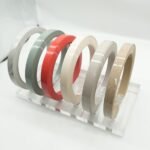
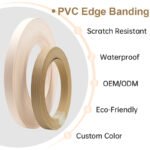
For furniture makers, panel processors, and interior product brands procuring PVC film in industrial volume — this guide outlines the four main film types and describes where each one fits and how to select the appropriate grade for your needs.
PVC film is one of the most flexible decorative surface materials in furniture and interior manufacture. One base polymer — polyvinyl chloride — is processed into four vastly different products based on how it will be used: stretched over a 3D profile, glued flat onto a panel, heat and pressure fused, or peeled from a release liner and applied to a surface by hand.
Each class is unique, and has its own thickness range, adhesive system, decor library and sourcing strategy. Buy the wrong one and you’re out some dough.
Getting the right one – in the right thickness, with the right surface treatment – is the difference between a furniture line that holds up for a decade and one that falls apart in the first sticky summer.
This guide goes through all four categories from a manufacturer’s viewpoint, with the technical details B2B buyers really want.
PVC film is one of the most versatile decorative surface materials in furniture and interior manufacturing. A single base polymer — polyvinyl chloride — gets engineered into four very different products depending on how it will be applied: stretched over a 3D profile, glued flat onto a board, fused under heat and pressure, or peeled off a release liner and pressed onto a surface by hand.
Each category has its own thickness range, adhesive system, decor library, and sourcing logic. Buying the wrong one wastes money. Buying the right one — at the right thickness, with the right surface treatment — is the difference between a furniture line that holds up for ten years and one that delaminates in the first humid summer.
This guide walks through all four categories from a manufacturer’s perspective, with the technical detail B2B buyers actually need.
What Is PVC Film?
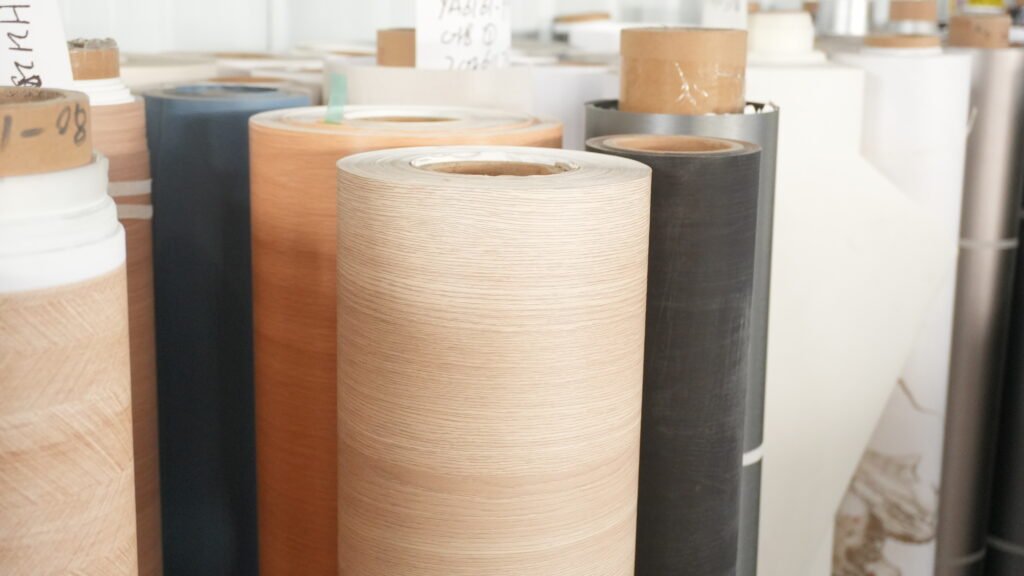
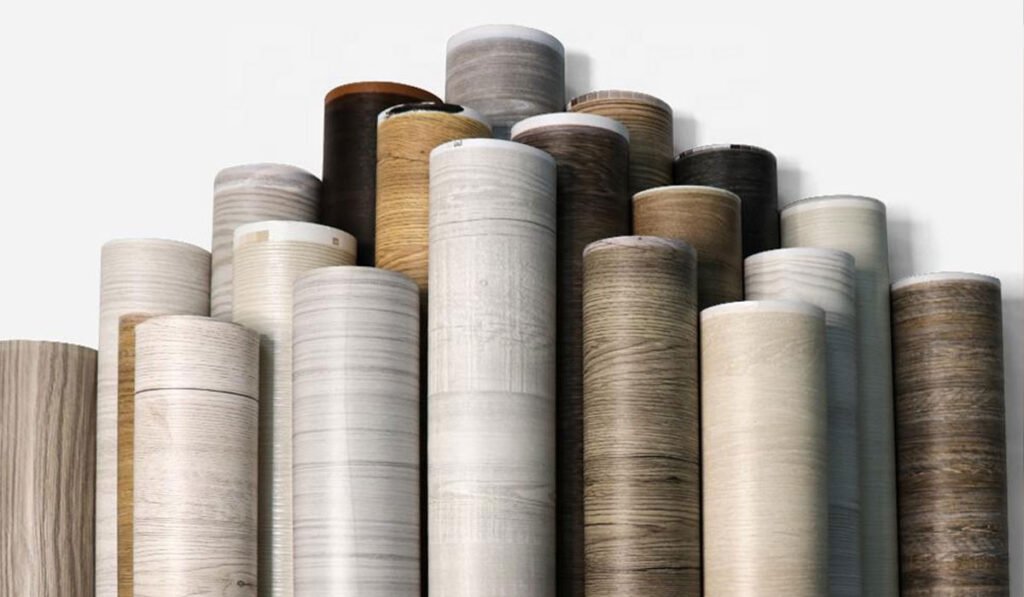
PVC film is a sheet of polyvinyl chloride (PVC) that is thin and flexible — usually from 0.10 mm up to 0.50 mm thick — printed and debossed with a decorative design pattern, and then laminated onto a solid substrate such as MDF, particleboard, plywood, WPC or aluminum composite to produce a finished surface.
It functions in the same way as natural veneer, PET film or melamine paper, but offers three commercial benefits which have allowed it to become the preferred option for mid-market furniture and cabinetry across the globe:
- 3D wrap-ability — PVC softens under heat and conforms to profiled edges, something melamine paper cannot do
- Decor variety — over 1,000 commercially available patterns: wood grains, marbles, solid colors, metallics, fabrics
- Cost-to-performance ratio — significantly cheaper than real veneer, more durable than melamine, easier to source than premium PET
The film layer is waterproof for PVC film, although the water resistance of the laminated assembly is also a function of the substrate and edge sealing. It was about 4mm thick and it was not designed to be food-contact-safe - you need a particular compliant formulation for that. It is somewhat recyclable via specialized PVC reclaim streams, however the majority of the material is funneled into general waste streams.
The below four functional categories are not different polymers — it is the same flexible PVC formulated for four lamination techniques.
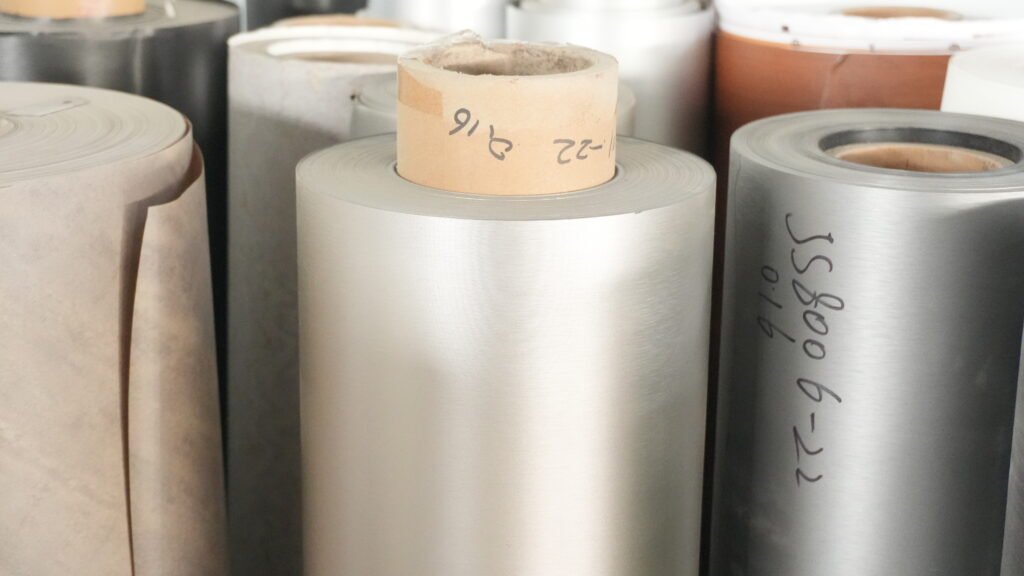
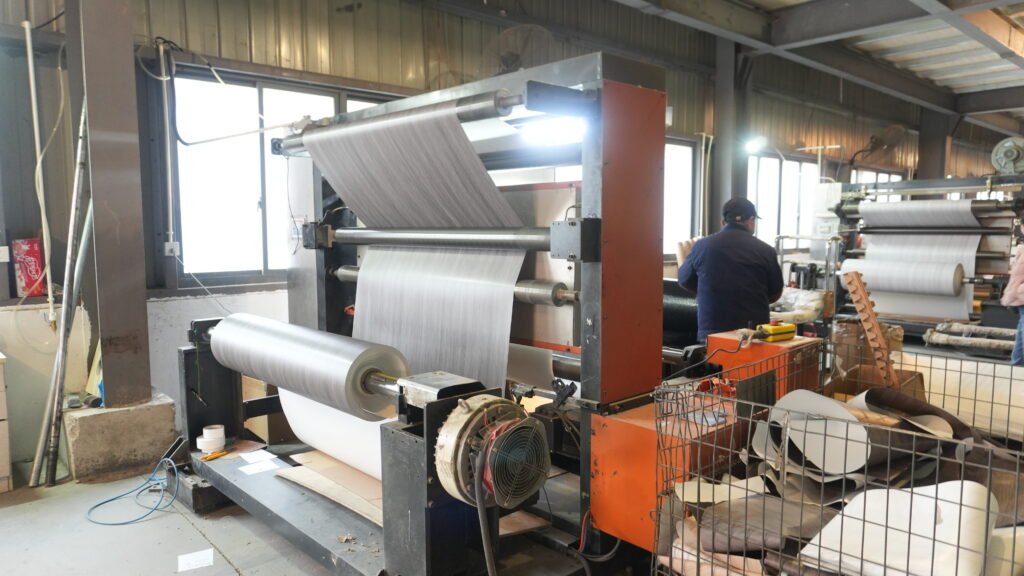
Vacuum Forming PVC Film (Thermoforming / 3D Membrane Press Film)
Vacuum forming film is what shaped the kitchen cabinet door industry today.
How It Works
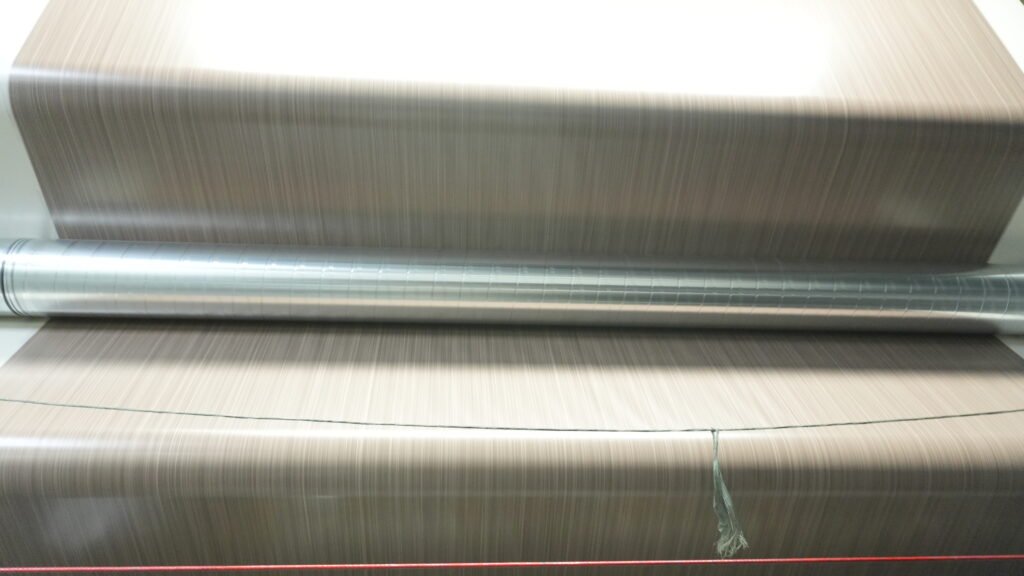
A flat MDF door blank — typically with routed edge profiles, raised panels, or decorative grooves — is inserted into a membrane press. A sheet of PVC vacuum forming film is hanging above it. The press heats (approx. 110–140°C depending on grade), evacuates air, and the softened film stretches down over every contour of the door, adhering to the pre-applied adhesive on the MDF surface.
the result: a full-face skin — skin on the face and edges of the door, wrapped around a profiled door — no banding needed, no seams visible.
Specifications
- Thickness: 0.25 – 0.45 mm (thicker than other PVC film categories because it has to stretch without thinning out on tight radii)
- Stretch ratio: 150–250% elongation at forming temperature
- Forming temperature window: typically 110–140°C
- Width: 1300 / 1400 mm standard
- Surface finishes: high-gloss, super-matte, soft-touch, anti-fingerprint, woodgrain synchronized embossing
Applications
- Kitchen cabinet doors (the largest single application worldwide)
- Bathroom vanity doors
- Wardrobe doors and drawer fronts
- Profiled MDF wall panels
- Office furniture doors
Specification Pitfalls to Avoid
The number one error B2B buyers make when purchasing vacuum forming film is asking for too thin a gauge in order to cut costs. A 0.30 mm film on sharp edge radii will thin out to 0.15 mm or less, marking the substrate visible through the film. For profiled doors with crammed radii, 0.40 mm is the more secure starting point.
The second most frequent error is using furniture-grade film in commercial uses without UV stabilization — yellowing appears in 18 months in sunny climates.
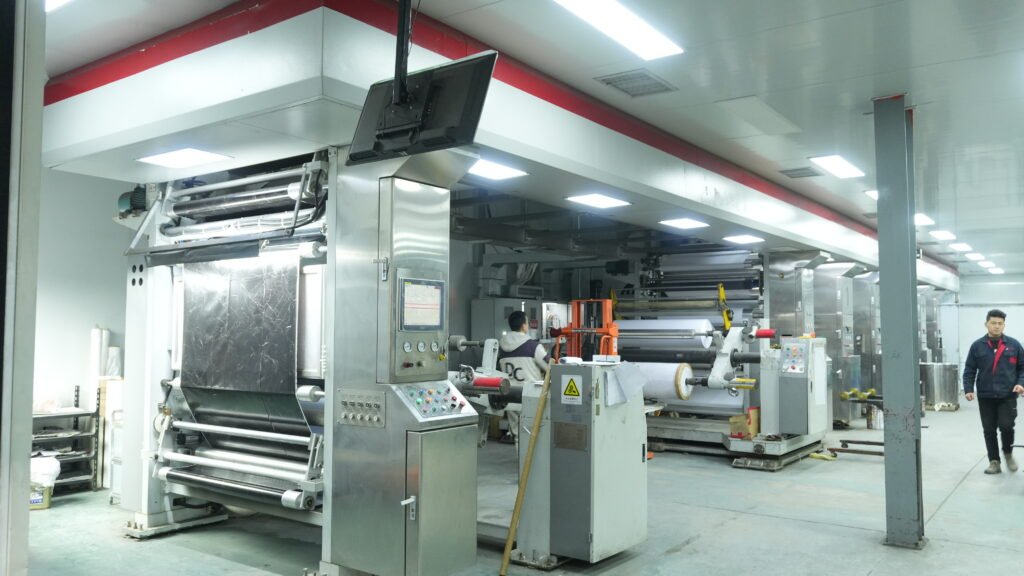
Flat Lamination PVC Film
Flat lamination film – is the category of applications for flat panel in board products such as cabinet bodies, shelving, flat door faces, wall panels and furniture cases.
How It Works
A roll of PVC film runs through a flat lamination line continuously. The board substrate (usually particleboard, MDF or plywood) travels in line. The glue – usually PUR hotmelt or EVA – is either applied to the surface of the board or the film is pre-coated on the back. In one pass, heat and pressure rollers bond the film to the substrate. The laminated panel is then rip cut and edgebanded.
Specifications
- Thickness: 0.10 – 0.20 mm (thinner than vacuum forming film — no need to stretch)
- Tolerance: ±0.01 mm (tight tolerance matters because flat surfaces show any thickness variation under raking light)
- Width: 1260 / 1300 / 1400 mm to match standard board widths
- Roll length: 300 – 500 meters
- Color consistency: ΔE ≤ 1.0 across production batch
- Adhesion: compatible with PUR, EVA, and water-based glue systems
Applications
- Cabinet bodies and shelving panels
- Flat door faces (paired with edge banding for the edges)
- Wall cladding panels on MDF or WPC substrate
- Office furniture worksurfaces and side panels
- Retail fixtures and display units
Why Flat Lamination PVC Film Often Beats Melamine Paper
One of the common questions asked in B2B is “PVC film vs melamine paper — what is better for flat lamination?” The truth lies in the use :
- Cost: melamine paper wins
- Scratch resistance: melamine paper wins (it’s harder)
- Water resistance: PVC film wins decisively
- Edge sealing: PVC film wins (paper edges absorb moisture)
- 3D embossing depth: PVC film wins (deeper synchronized texture)
- Repairability: PVC film wins (can be reheated and reseated)
For the kitchen, bathroom and any moist environment, PVC flat lamination film is the default option. Below the point of office furniture for use in dry environments, melamine paper still has a role, albeit at the lowest price point.
Coordinating with Edge Banding
One important sourcing detail that most first time buyers overlook: when you laminate a panel a with a layer of PVC film, the edges still need to be sealed with matching edge banding. The film is applied to the face; PVC or ABS edge banding is applied to the four edges. Ordering them from the same vendor allows you to get a color match— ΔE ≤ 1.0 between the film and the banding tape is what the industry uses as a benchmark.
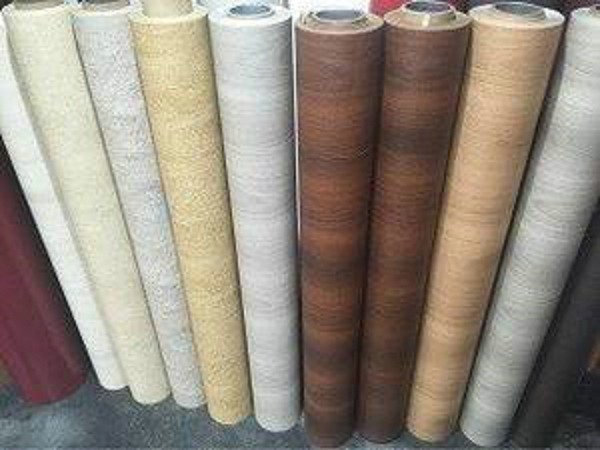
Laminated PVC Film
What is meant by layered or laminated film — in the sense of PVC film products is, that the film layers are pre-laminated with a further functional layer prior to being sent to the customer’s lamination line. This category has some overlap with flat lamination film, however the key difference is the multi-layer construction.
How It Differs from Single-Layer Film
A standard PVCfilm is a single printed and embossed sheet. A laminated PVC film has one or more additional layers attached during production:
- Protective topcoat layer — typically a transparent PU or acrylic film bonded on top to add scratch resistance and chemical resistance
- Pre-applied adhesive layer — an EVA or PUR adhesive film bonded to the back, eliminating the need for separate glue application
- Backing reinforcement layer — sometimes a non-woven or paper backing for dimensional stability
Specifications
- Total thickness: 0.20 – 0.40 mm (sum of all layers)
- Topcoat hardness: ≥ 3H pencil hardness when topcoat is specified
- Pre-applied adhesive: activated at 80–110°C depending on system
- Shelf life: 6–12 months when adhesive layer is included
Applications
- High-touch surfaces requiring extra scratch and chemical resistance (kitchen worktops, dining tables, retail counters)
- Customers without their own glue application equipment — the pre-applied adhesive eliminates one process step
- Premium hospitality and commercial projects where the topcoat’s anti-fingerprint or anti-bacterial properties are specified
When to Choose Laminated Over Standard Film
When your lamination line is already set up for PUR glue application, regular one-layer film is more cost effective. If you are going into the lamination business without existing glue infrastructure, laminated film with pre-applied adhesive enables you to begin production with less complex equipment — just heat and pressure. The price per square meter is higher, but the capital investment in equipment is lower.
This is the same logic that makes pre-glued edge banding popular among smaller cabinet shops.
Self-Adhesive PVC Film
Self-adhesive film – this product sector is designed for use in areas where heat lamination is not applicable, such as the renovation of used furniture, installation at the location, signs, and commercial markets close to do-it-yourself.
How It Works
The film has a pressure sensitive adhesive (PSA) layer on one side, which is protected by a release liner. The liner is peeled off by the installer, who places the film on a clean substrate and then presses it — typically with a squeegee or roller — to remove air bubbles. No heat, no glue mixing, no industrial equipment needed.

Specifications
- Thickness: 0.08 – 0.20 mm (typically thinner than other categories — needs to flex during installation)
- Adhesive type: solvent-based acrylic PSA (highest durability) or water-based acrylic PSA (lower VOC)
- Application temperature: 10–35°C ambient
- Removability: removable grades (1–3 year service life) vs permanent grades (5–10+ year service life)
- Conformability: stretches around moderate curves without heat; cannot wrap deep 3D profiles
Applications
- Furniture refurbishment — old cabinet doors and worktops resurfaced without replacing
- Hotel and retail renovations — fast on-site installation during overnight closure windows
- Architectural signage and wayfinding
- Commercial vehicle interior surfacing
- Trade show and exhibition fixtures — temporary installations using removable grades
Permanent vs Removable — A Common Buyer Question
SDE PAA data reveals buyers often querying “how long does self-adhesive pvc film last” and “is it possible to remove self-adhesive pvc film.” It depends on which grade you buy:
- Removable grade — designed to peel cleanly after 1–3 years, typically used for short-term retail displays, rental properties, and seasonal installations. Leaves no residue when removed within the rated service life.
- Semi-permanent grade — 3–7 year service life, removable with some adhesive residue that requires solvent cleanup.
- Permanent grade — 5–10+ year service life, treated as a permanent surface. Removal damages the substrate.
The wrong grade being specified is the number one complaint within the self-adhesive sector. A hotel group that purchases a permanent grade for a planned 18-month renewal cycle will find itself facing costly substrate repair when it’s time to recoat once again.
Comparison Table: Four PVC Film Categories at a Glance
| Parameter | Vacuum Forming | Flat Lamination | Laminated | Self-Adhesive |
|---|---|---|---|---|
| Chinese name | 吸塑膜 | 平贴膜 | 层压膜 | 自粘膜 |
| Thickness range | 0.25–0.45 mm | 0.10–0.20 mm | 0.20–0.40 mm | 0.08–0.20 mm |
| Application method | Membrane press + vacuum + heat | Roll lamination + glue + heat | Roll lamination (with pre-applied adhesive option) | Peel + press (no heat) |
| Equipment required | Industrial membrane press | Flat lamination line | Flat lamination line (simpler with pre-glued grade) | Squeegee / roller |
| Substrate compatibility | Profiled MDF | Flat MDF, particleboard, plywood, WPC | Flat boards | Any clean smooth surface |
| Best applications | Kitchen cabinet doors, profiled wardrobes | Cabinet bodies, wall panels, flat doors | Premium surfaces, customers without glue line | Refurbishment, signage, on-site installation |
| Typical service life | 10+ years | 10+ years | 10+ years | 1–10 years depending on grade |
How to Specify PVC Film for B2B Procurement
Five questions decide the spec:
Frequently Asked Questions
Q: What is PVC film used for? PVC film is applied as a decorative surface layer on furniture, cabinet doors, wall panels, automotive strippings and signage. It is bonded to rigid substrates like MDF, particleboard, WPC or aluminum composite to provide wood grain, marble, solid colour or specialty finishes that are far more cost effective than natural materials.
Q: Is PVC film waterproof? The film PVC est étanche. Is Coating Side Waterproof?Sealing of the substrate and armouring of the edges. Water goes through the unsealed edges not the film face when a finished panel is waterproof – but not through the edges of the film.
Q: What is the difference between PVC film and PVC sheet? PVC film is thin (under 0.5 mm) and flexible, used as a surface lamination layer. PVC sheet is thicker (0.5 mm to several millimeters) and rigid, used as a standalone construction material — partition panels, signage substrates, etc.
Q: What temperature is needed for PVC vacuum forming? Most PVC vacuum forming films activate between 110°C and 140°C. The exact window depends on grade and thickness — your supplier should provide a process datasheet for each batch.
Q: What is the difference between PVC and PET for vacuum forming? PET film offers higher scratch resistance and better long-term color stability but costs 30–50% more, requires tighter process control, and has a narrower forming temperature window. PVC remains the volume-market standard for kitchen and wardrobe doors; PET is positioned as the premium option.
Q: PVC film vs melamine paper — which is better? PVC film is better for water resistance, edge sealing, and deep embossing. Melamine paper is better for hardness, scratch resistance, and cost. For kitchens, bathrooms, and humid climates, choose PVC film. For dry-environment budget office furniture, melamine paper is still viable.
Q: What glue is used for PVC film lamination? PUR (polyurethane reactive) hot-melt is the industry standard for flat lamination — best heat and water resistance. EVA hot-melt is cheaper and faster but less heat-resistant. Water-based dispersion glue is used in lower-volume operations and where VOC limits are strict.
Q: How long does self-adhesive PVC film last? Removable grade: 1–3 years. Semi-permanent grade: 3–7 years. Permanent grade: 5–10+ years. Service life is shortened by direct UV exposure, high humidity, and frequent cleaning with solvents.
Q: Can self-adhesive PVC film be removed? Removable grade peels off cleanly within its rated service life. Semi-permanent grade removes with adhesive residue requiring solvent cleanup. Permanent grade cannot be removed without damaging the substrate — plan the renovation cycle accordingly.
Q: Is PVC film recyclable? PVC is technically recyclable through specialized PVC reclaim streams, but the infrastructure varies by country. In most markets, laminated PVC film products go to general waste. Closed-loop programs exist in Germany, the Netherlands, and Japan, and are slowly expanding.
Q: What thickness of PVC film should I use? Vacuum forming: 0.30–0.45 mm. Flat lamination: 0.12–0.20 mm. Laminated (multilayer): 0.20–0.40 mm. Self-adhesive: 0.10–0.18 mm. Going thinner to save cost usually creates more problems than it solves.
Q: Can PVC film be 3D laminated? Yes — that is precisely what vacuum forming film does. Standard flat lamination film cannot wrap 3D profiles; it will crack at the edges. Always specify vacuum forming grade for profiled substrates.
Sourcing PVC Film from China: What B2B Buyers Should Look For
China produces the majority of the world’s PVC decorative film supply. The supplier landscape ranges from massive integrated factories to small workshops repackaging other manufacturers’ rolls. For B2B buyers, four sourcing criteria separate reliable suppliers from the rest:
1. Direct factory or trading agent? A direct factory controls formulation, color matching, and QC turnaround. A trading agent passes complaints through a layer of middlemen — defects take weeks to resolve. Ask to see the production line.
2. Color matching capability Industry benchmark: ΔE ≤ 1.0 against the approved sample, batch to batch. Ask the supplier how they verify it (spectrophotometer readings should be available with every batch). A supplier without spectrophotometric QC cannot guarantee consistency across reorders.
3. Documentation depth Project-grade B2B buyers need REACH, RoHS, EN 13501-1 fire test reports, CARB, Prop 65, and (for some markets) low-VOC certification. Suppliers serving only domestic Chinese furniture have thin documentation. Suppliers experienced in export to Europe, North America, and Australia maintain current certificates for each grade.
4. Lead time honesty Stock decors: 15–25 days from order to ship is realistic. Custom production: 35–45 days. Anyone promising stock-decor shipment in under 10 days is either misstating their inventory or quoting from a trading house’s inventory they don’t actually control.
About LUYAO
LUYAO manufactures decorative surface materials for furniture and panel industries from our facility in China. Our product range covers PVC laminated film, PVC edge banding, ABS edge banding, and color-matched accessories — supplied to cabinet factories, panel processors, wall panel manufacturers, and contract project suppliers worldwide.
Whether you need vacuum forming film for kitchen cabinet doors, flat lamination film for wall panels, laminated film for premium projects, or self-adhesive film for refurbishment work — we ship from one factory, with one QC system, and color-matched edge banding from the same production source.
Request samples or a quotation:
- emily.gu@asiaedgebanding.com
- WhatsApp / WeChat: +86-15618525178