


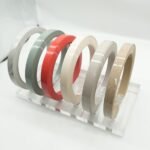
Wood Grain ABS Edge Banding — Oak, Walnut, Teak and 200+ Patterns from LUYAO Factory
Wood grain is the largest single category in furniture wood grain abs edge banding demand worldwide, and the most demanding category to produce correctly.
Pattern alignment, embossing depth, color layering, and surface gloss all have to land within visual tolerance of the panel surface — or the wood grain abs edge banding gives away the seam from across the room.
LUYAO has manufactured wood grain ABS edge banding since 2002. This page covers the full pattern range, the technical differences between embossed and printed wood grain, how to match an edge band to your specific board brand, and how wood grain ABS compares with PVC and melamine alternatives.
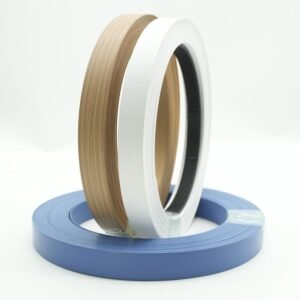
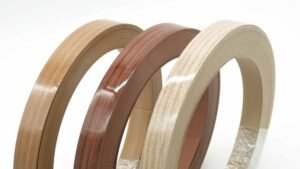
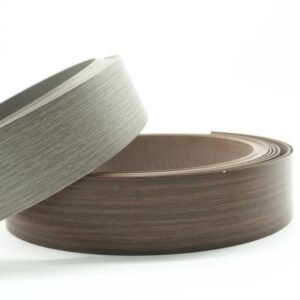
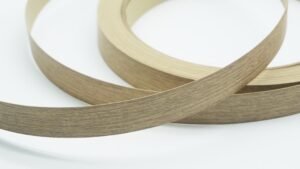
What Is Wood grain ABS edge banding
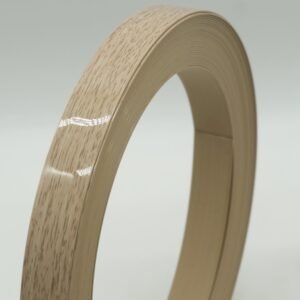
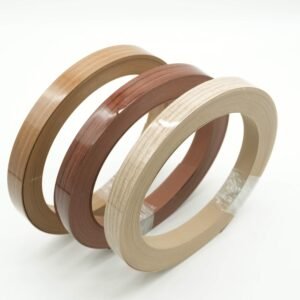
Wood grain ABS edge banding is a polymer edge strip extruded from virgin ABS resin, surface-printed or surface-embossed with wood texture patterns that visually replicate natural wood species. It is bonded to the cut edge of melamine-faced chipboard, MDF, or plywood panels using hot-melt or EVA adhesive on automatic edge banding machines.
The purpose is dual: functional and visual. Functionally, the edge band seals the exposed panel core from moisture, impact, and chipping. Visually, it extends the wood grain appearance of the panel surface continuously around the edge, eliminating the visible color seam between the panel face and the panel core.
A correctly specified Wood grain ABS edge banding achieves three things at once:
- Pattern continuity with the panel surface (grain direction, knot frequency, line spacing)
- Color match within 98%+ similarity under standardized D65 lighting
- Surface texture match between the embossed wood grain abs edge banding and the textured panel
When all three align, the finished furniture piece looks like solid wood from a distance of one meter. When any one of the three fails, the edge gives itself away as a manufactured seam.
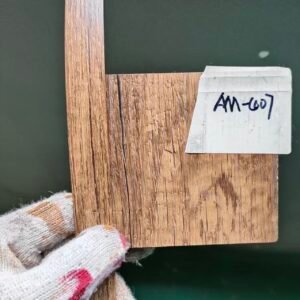
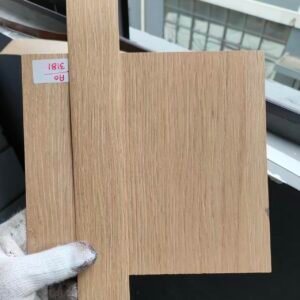
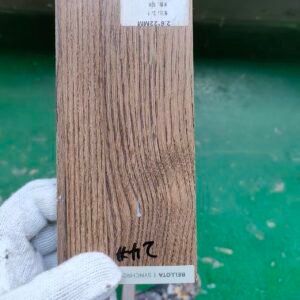
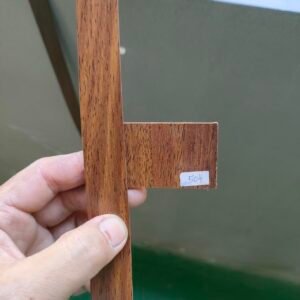
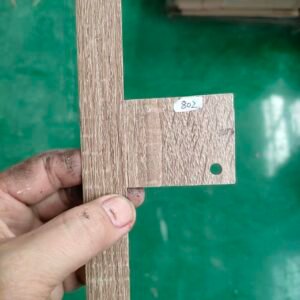
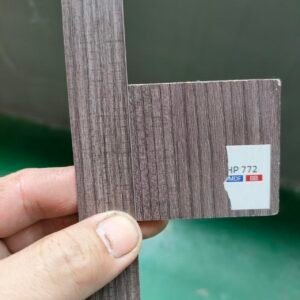
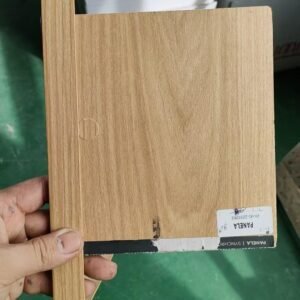
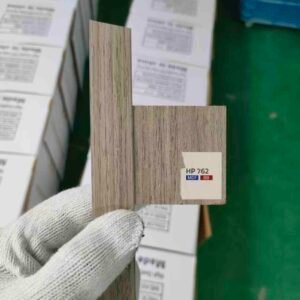
LUYAO Wood Grain Pattern Range
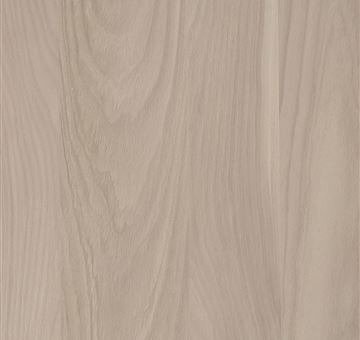
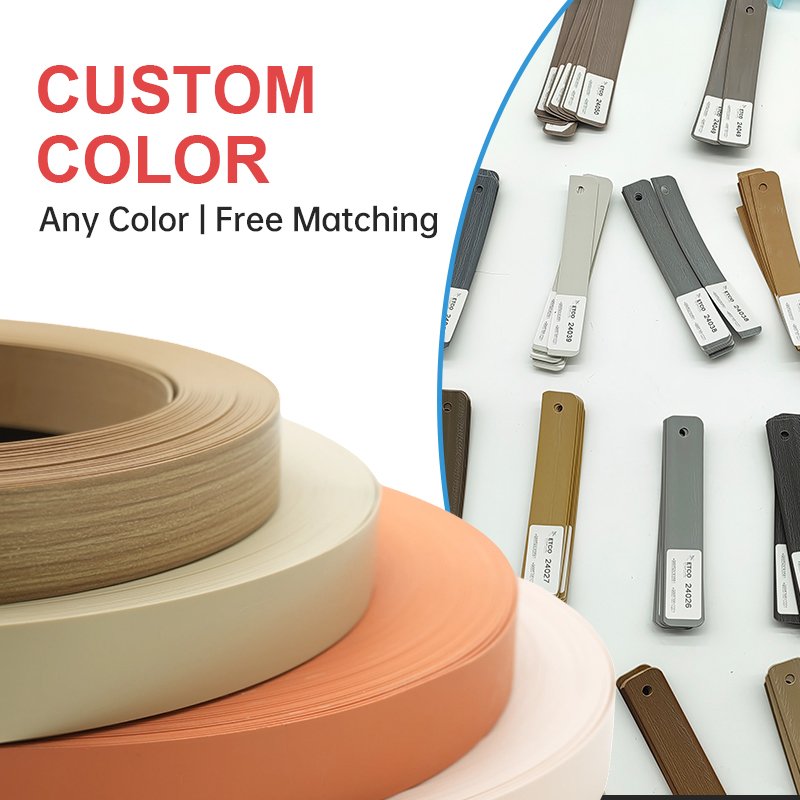
[ Catalog image placeholder — full display board with all wood grain categories arranged by species, embossed and printed variants shown side by side ]
LUYAO maintains over 200 wood grain patterns in continuous stock, organized into six primary species categories. All patterns are designed to align with current furniture board manufacturer décor catalogs — meaning the Wood grain ABS edge banding patterns are not generic, but specifically matched to the wood grain papers that major board mills are pressing onto melamine boards in any given year.
Oak Patterns
The single largest demand category globally. Oak grain ranges from tight straight grain (rift-cut oak) to wide cathedral grain (flat-sawn oak), with color variants spanning bleached white oak, natural light oak, honey oak, smoked oak, rustic oak, and deep dark oak.
LUYAO currently stocks 45+ oak patterns, with strongest seasonal demand for light natural oak and rustic oak in the European-influenced markets (Latin America, the Gulf), and white-washed oak trending strongly in modern kitchen and wardrobe designs since 2022.
Walnut Patterns
The premium category — walnut signals high-end furniture and commands a price premium in finished goods. LUYAO stocks 30+ walnut patterns covering American black walnut, European walnut, smoked walnut, and decorative walnut variants with high contrast streaking.
The dominant pattern in current Middle East luxury furniture is dark American walnut with visible grain figuring — used widely in Saudi and UAE wardrobe and TV cabinet rollouts.
Teak Patterns
Strong demand in tropical and coastal markets where teak signals durability and outdoor heritage. LUYAO stocks 20+ teak patterns including Burma teak, Indonesian teak, golden teak, and weathered teak.
Largest order volumes go to Brazil, where teak grain dominates mid-tier residential furniture, and to Southeast Asian export buyers serving the Australian market.
Maple Patterns
Light, clean, and modern. Maple is dominant in office furniture, contract furniture, and Nordic-influenced residential design. LUYAO stocks 18+ maple patterns including hard maple, soft maple, sycamore maple, and bleached maple.
Ash Patterns
Rising category since 2023 — ash grain offers a strong directional pattern with lighter coloring than oak, popular in modern Scandinavian-influenced furniture lines. LUYAO stocks 15+ ash patterns.
Decorative Wood Patterns
Ebony, zebrawood, rosewood, beech, cherry, pine, and reclaimed/distressed wood looks. Specialty patterns serve specific design segments — hotel project furniture, retail display, and high-end residential. LUYAO stocks 80+ decorative patterns across these categories, with custom pattern development available for project orders above 50,000m.
Embossed vs Printed Wood Grain — What’s the Difference
This is the single most important technical distinction in Wood grain ABS edge banding, and the one that buyers most often get wrong on first orders.
Printed Wood Grain (Flat Surface)
The wood texture is printed onto the ABS surface using gravure printing rollers, then sealed with a transparent topcoat.
The surface remains completely flat — when you run a fingernail across the wood grain abs edge banding, you feel no texture, only smooth polymer.
Best matched to: Smooth-surface melamine boards, low-pressure laminate panels, and standard residential furniture where the panel surface itself has no embossed texture.
Cost: Lower per meter than embossed. Production lead time: Faster, since no embossing roller setup is required.
Embossed Wood Grain (Textured Surface)
After printing, the ABS surface passes through a heated embossing roller that physically presses wood pore texture into the polymer. When you run a fingernail across the edge band, you feel shallow grooves following the printed grain pattern — replicating the touch of real wood.
Best matched to: Textured melamine boards (commonly labeled “synchronized embossed” or “ST” finish by board mills), where the panel surface itself has embossing in register with the printed grain.
Cost: 15-25% premium over printed. Production lead time: Slightly longer due to embossing roller setup.
Synchronized Embossing — The Premium Tier
The highest tier of Wood grain ABS edge banding is synchronized embossing, where the embossed texture on the edge band aligns precisely with the embossed texture on the panel surface. When the Wood grain ABS edge banding is bonded to the panel, the wood pore texture flows continuously from the panel face around the edge — visually and tactically indistinguishable from solid wood at normal viewing distance.
This requires the edge banding manufacturer to have the exact embossing plate that matches the board mill’s décor paper. LUYAO maintains synchronized embossing capability for the major board brands sold into our primary export markets — Egger, Kronospan, Arauco, Masisa, and several regional Chinese board mills.
Which Should You Order
| Your panel surface | Order this edge band |
|---|---|
| Smooth, flat melamine | Printed wood grain |
| Lightly textured melamine | Embossed wood grain (standard) |
| Synchronized embossed melamine (ST finish) | Synchronized embossed edge band |
| High-gloss laminate panel | Printed wood grain with gloss topcoat |
If you’re not sure what surface your panels have, send a panel sample. Our team identifies the board mill and finish type from the décor code and matches accordingly.
How to Match Wood grain ABS edge banding to Your Panel
Wood grain matching is harder than solid color matching because three variables have to align simultaneously: color, pattern, and texture. Here’s how the LUYAO matching workflow handles it.
Step 1 — Send a Panel Sample, Not a Photo
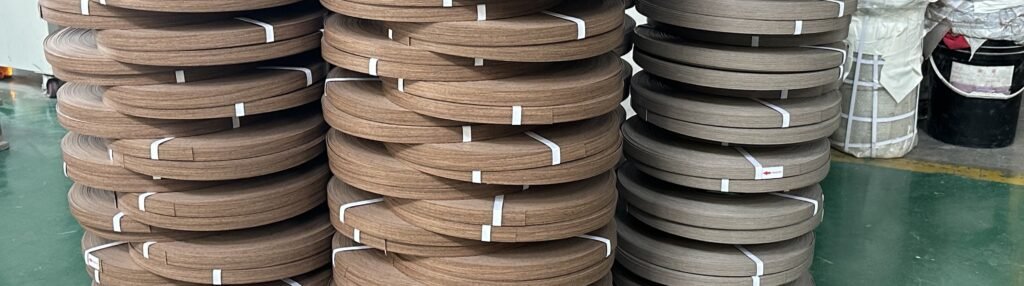
Photos are unreliable for wood grain matching. Lighting temperature, camera white balance, and screen calibration all shift the apparent color of wood textures. Every serious wood grain match starts with a physical panel sample of at least 200mm × 200mm, large enough to show full pattern repeat.
If you have the décor code from the board mill (Egger H3303, Kronospan K001, Arauco Lina, etc.), include it. We maintain cross-reference tables for the major board mills’ décor catalogs, which shortcuts the matching process by 3-5 days.
Step 2 — Pattern Identification
Our color lab first identifies which of our 200+ stocked patterns is closest to your panel. In roughly 70% of cases, an existing stocked pattern is within visual tolerance of the panel and proceeds directly to color verification.
For the remaining 30%, we develop a custom pattern by adjusting print roller selection, color layer count, and embossing depth to match the panel.
Step 3 — Color Layer Matching
Wood grain printing uses 3-5 ink layers to build depth: a base tone, a mid-tone for grain lines, a dark tone for figuring and knots, and optional accent layers for character. Our pressroom team adjusts each ink layer’s hue and density to match the panel under standardized D65 lighting.
Step 4 — Embossing Depth Calibration
If your panel has a textured surface, the embossing depth on the edge band has to match. Too shallow — the edge looks plastic next to a textured panel. Too deep — the embossing reads as exaggerated under raking light. Standard embossing depth ranges from 0.05mm to 0.15mm depending on the wood species being replicated.
Step 5 — Trial Run and Buyer Approval
A 50-100 meter trial extrusion is produced and shipped back to the buyer. You compare against your own panel under your own warehouse lighting and your own customers’ typical viewing conditions. Written approval locks the pattern, color formulation, and embossing plate under your customer account.
Total timeline: 10-14 days for standard wood grain matching, 14-18 days for synchronized embossing development.


Wood Grain ABS vs PVC vs Melamine Edge Banding
Wood grain is available in multiple edge banding materials. Here’s how they compare on the dimensions that matter for furniture manufacturing.
| Dimension | Wood Grain ABS | Wood Grain PVC | Wood Grain Melamine |
| Material base | Virgin ABS polymer | PVC polymer | Paper impregnated with melamine resin |
| Environmental | No chlorine release when cut or heated | Releases chlorine compounds when heated | Paper-based, low emission |
| Impact resistance | High | Medium | Low (brittle) |
| Heat resistance | High | Medium | Medium |
| Color consistency batch-to-batch | Excellent (masterbatch-locked) | Good | Variable (paper dye lots) |
| Embossing depth capability | Up to 0.15mm | Up to 0.10mm | Limited |
| Synchronized embossing | Available | Available | Not available |
| Edge sealing after cutting | Self-sealing on heating | Self-sealing on heating | Requires sealant |
| Compatible with auto edge banding machines | Yes (all major brands) | Yes | Yes, with specific glue |
| Cost per meter (relative) | Baseline | 15-20% lower | 30-40% lower |
| Regulatory acceptance — EU | Fully accepted | Restricted in some applications | Accepted |
| Regulatory acceptance — Latin America | Fully accepted, growing preference | Accepted, declining | Accepted |
| Regulatory acceptance — Middle East | Fully accepted, preferred for premium | Accepted | Accepted for low-tier |
| Typical end-use | Mid to premium furniture, contract, hotel | Budget residential, mass production | Low-tier residential, flat-pack |

When to Choose Wood Grain ABS
- Mid-tier to premium residential furniture targeting export markets
- Contract furniture (offices, hotels, hospitals) requiring impact durability
- Markets with rising environmental compliance requirements (EU, Australia, Canada, increasingly Latin America)
- Furniture lines where panel surface uses synchronized embossing
- Long warranty periods where color consistency across reorders matters
When PVC or Melamine Might Be Acceptable
- Pure cost-driven flat-pack furniture for domestic distribution
- Disposable or short-cycle furniture (rental, dormitory, event)
- Markets with no chlorine emission restrictions
Most furniture markets globally are migrating from PVC to ABS as the preferred wood grain abs edge banding material. LUYAO has observed this shift accelerating in Brazil, Chile, and the Gulf since 2021, with several large board distributors converting their full edge banding catalog from PVC to ABS across 2023-2024.
Application Scenarios
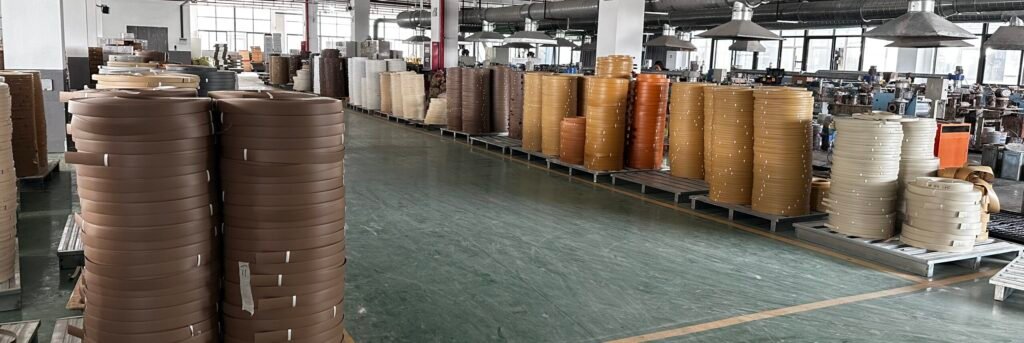
Wood grain ABS edge banding is used across the full range of melamine-faced and laminated panel furniture. The patterns and finishes specified vary significantly by application segment.
- Kitchen Cabinets — Light oak, white-washed oak, and walnut dominate. Embossed texture preferred to match the textured melamine doors common in mid-tier kitchen lines. Thickness typically 1mm or 2mm for door edges, 0.4mm or 0.5mm for cabinet box edges.
- Wardrobes and Closets — Walnut and dark oak in the Middle East luxury segment; light oak and maple in European-influenced Latin American markets. Door edges 1mm-2mm, internal shelving 0.4mm-0.8mm.
- Office Furniture — Maple, ash, and light oak dominate. Workstation systems require high-volume single-pattern orders with strict batch color consistency over 2-3 year reorder cycles. LUYAO maintains color-locked production records on long-term office furniture accounts for this reason.
- Hotel and Contract Projects — Walnut, teak, and decorative patterns. Project orders are typically single-shot — produced once for one hotel rollout — but require exact color matching to architect-specified wood veneer samples. Lead time 18-25 days with dedicated production scheduling.
- TV Cabinets and Living Room Furniture — Wide pattern variety, regional preferences strong. Brazilian market favors teak and dark oak; Saudi market favors walnut with high-gloss finish; Kazakhstan market favors light oak and ash.
- Bathroom Vanities — ABS preferred over PVC for moisture environments. Water-resistant base color layers under the wood grain print prevent edge whitening over time.
Specifications Summary
| Parameter | Range |
|---|---|
| Material | Virgin ABS resin, surface-printed and optionally embossed |
| Thickness | 0.4mm, 0.5mm, 0.8mm, 1mm, 2mm, 3mm |
| Width | 9mm to 120mm (custom widths on request) |
| Standard roll length | 100m (50m and 200m available) |
| Surface finish options | Printed flat, embossed, synchronized embossed, high-gloss, matte |
| Color match accuracy | 98%+ to approved panel sample, spectrophotometer-verified |
| Pattern range in stock | 200+ wood grain patterns across 6 species categories |
| MOQ | 5,000 meters per pattern/color |
| Sample lead time | 7-10 days for color-matched samples |
| Production lead time | 15-20 working days standard, 18-25 days for synchronized embossing |
| Packaging | Inner plastic film, outer carton, palletized for container loading |
| Container capacity | Approximately 80,000-120,000 meters per 40HQ |
| Certifications | SGS, REACH, ROHS, plus destination-specific on request |
Frequently Asked Questions
Thicker edges allow for radius routing after bonding, giving a softened edge profile that’s common in modern furniture design.